Traffic in Highgate
As an old settlement, Highgate village is a focal point for the meeting of several roads. Archway Road was built in 1813 as an alternative for the steep Highgate Hill, but the original network remains and roads are sometimes narrow and unsuited to the demands now made of them.
The boundary between the boroughs of Camden and Haringey runs down Highgate High Street / Hill, and Hornsey Lane and Dartmouth Park Hill form the boundary with Islington. Recent traffic planning has tended either to ignore Highgate village completely, or to consider one side and ignore the implications for the other side of the borough boundaries. For that reason in our requests to candidates and parties for the council elections we have focused on the essential need for boroughs to work together (see here). We do not know what future traffic schemes will emerge.
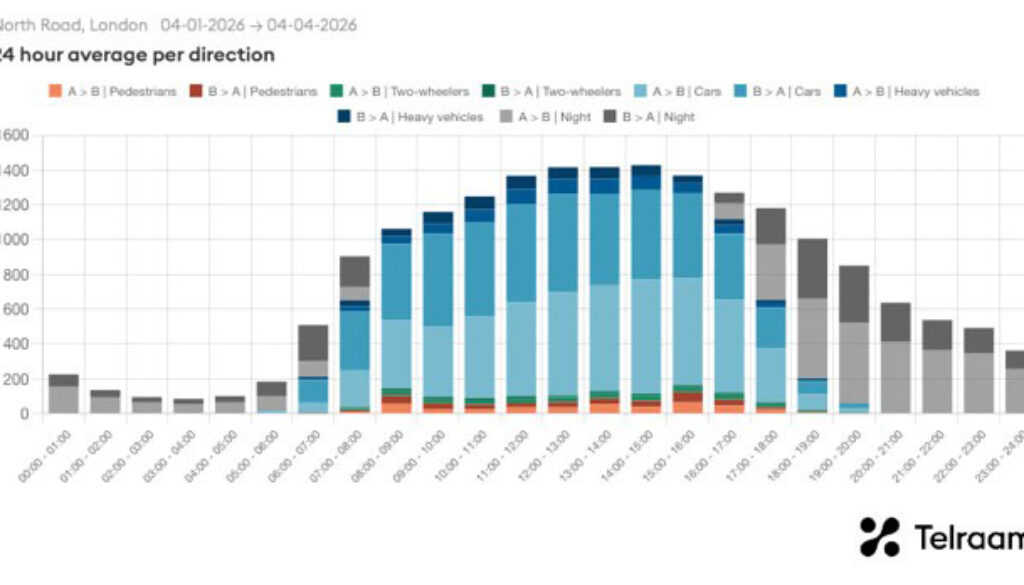
To help fill this gap and inform that discussion, the Highgate Society has installed traffic monitors. These Telraam devices use very low resolution video cameras to continuously count passing traffic, including large and small vehicles separately, two wheeled traffic, and pedestrians. They also provide statistical information on vehicle speeds. Anonymity and privacy is assured because exact locations of the devices are not disclosed, and the images captured are not retained by either the Society or Telraam.
The traffic information provided as a result is completely objective and the devices achieve a high level of accuracy for vehicles and two wheelers (bicycles and motorcycles).
A breakdown of vehicle types is available for daylight hours, and at night the devices switch to counting vehicles numbers using headlights, so night time counts do not distinguish vehicle types. For daylight counts, Telraam uses the term “heavy vehicles” for any vehicles which are not cars, so this includes vans, buses and trailers as well as HGVs. However, the advanced version available privately on the Society’s dashboard distinguishes in more detail.
Pedestrian counts are less accurate because groups of pedestrians cannot easily be separated into individuals. Where locations do not have a good clear view of both pavements, pedestrian counts will be understated. Where this applies, we’ve explained it in our comments on each road.
The data obtained by each device is uploaded every 15 minutes and is available on the public website in hourly counts. You can view the data on this site where you can navigate to Highgate using the map and then select the device for which you want to see data.
Uses so far
We used the data from the devices in responding to the Haringey Kerbside Strategy document, and were able to provide specific data on traffic movements and so question the categorisation of roads as primary or secondary. We were also able to highlight the relatively high numbers of pedestrians using Highgate High Street, highlighting the importance of its “place” function as somewhere people congregate. More recently in responding to the Archway Road traffic consultation, we referenced the high proportion of heavy vehicles, and the continuing high volume of traffic (compared to other roads) at night. We could also highlight concerns about speeding based on the statistical evidence collected, and will be able to see the impact of the introduction of the 20mph speed limit.
Next stages
We have two further devices waiting to be installed and will be moving some of our existing devices to extend the understanding of traffic volumes where we have data gaps. An important outcome will be to measure how much traffic would seek alternative routes or modes of travel if roads are closed or made one-way.
Other relevant information for traffic planning includes (i) turning movement data – that is, at each junction or roundabout, the numbers of vehicles turning in each direction; and (ii) origin and destination data – where traffic coming is from and going to.
Can you help?
If you live on a road where you think it would be useful to measure traffic, you may be able to help by hosting a device. Suitable locations are a window (usually on a first floor, raised ground floor or second floor) with an uninterrupted view over the road and both pavements. The position needs to be away from a junction and face the road straight on. You can get in touch using the Contact Us form on our website https://highgatesociety.com/about/contact/‘
Comments by road for traffic over the 3 month period from 4 January to 4 April 2026
The devices produce a huge amount of information, which is also available in graphical format. The full data set is only available on the Highgate Society’s dashboard, but a small selection of it with our observations and comparisons is in the links below.
A numerical summary can be accessed here.
Follow the links to each road or street
28 April 2026